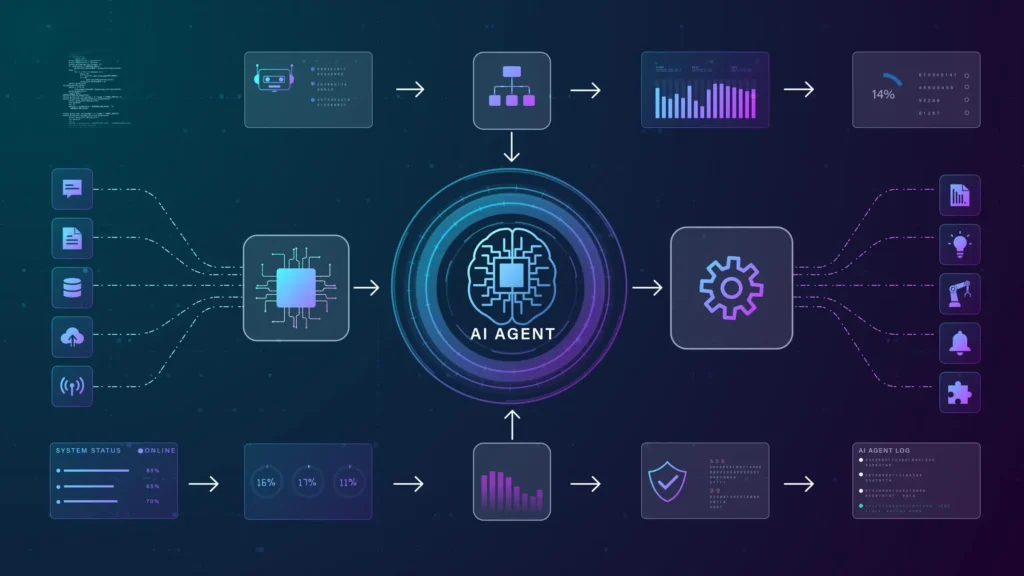
Artificial intelligence is moving beyond traditional chatbots and simple automation. The next evolution of AI is the rise of AI Agents — intelligent systems designed to understand goals, make decisions, use digital tools, and complete complex tasks with minimal human intervention.
Unlike traditional AI models that only provide answers, AI Agents can analyze information, create plans, execute workflows, and interact with different software platforms. This technology is expected to transform industries such as marketing, customer service, finance, healthcare, and business operations.
According to research and security guidance from NIST, organizations need new approaches to manage security, reliability, and risks as AI systems become more autonomous.
Businesses are constantly looking for ways to improve efficiency and reduce operational costs. AI Agents can help companies by:
For example, an AI Agent can automatically respond to customer questions, organize leads, generate reports, and assist employees with daily workflows.
AI Agents represent a major shift from software that follows instructions to systems that can understand objectives and complete tasks. As this technology develops, companies that adopt AI automation early may gain a significant competitive advantage.
The way businesses create content is changing rapidly. Artificial intelligence is revolutionizing photography, video production, advertising, and digital marketing by making high-quality content creation faster and more accessible.
Modern generative AI tools can create images, videos, audio, and written content within minutes. This allows businesses to produce more personalized marketing campaigns while reducing production time and costs.
According to Google AI Blog, generative AI technologies are opening new possibilities for creative industries and changing how people produce digital experiences.
AI-powered content creation helps brands:
For creative businesses, AI does not replace creativity; it enhances human imagination by providing new tools and possibilities.
The future of content creation will combine human creativity with artificial intelligence. Businesses that learn how to use AI effectively will be able to create better content, reach more customers, and compete in a faster digital world.
As artificial intelligence becomes more advanced, cybersecurity has become one of the most important challenges for organizations worldwide.
While AI provides powerful tools for protecting digital systems, it can also be used by attackers to create more sophisticated cyber threats. Hackers can use AI to automate attacks, generate realistic phishing messages, and discover vulnerabilities faster.
According to the World Economic Forum, cybersecurity risks are becoming more complex as digital technologies continue to evolve.
Organizations are using AI to:
AI-powered security systems can analyze huge amounts of data and recognize patterns that may be difficult for humans to detect.
As businesses become more dependent on technology, combining AI innovation with strong cybersecurity practices will be essential for protecting digital infrastructure.
Artificial intelligence has become one of the most influential technologies transforming businesses worldwide. Companies across different industries are adopting AI to improve productivity, optimize operations, and create better customer experiences.
From automated customer support to advanced data analysis, AI is helping organizations make faster and smarter decisions.
The Stanford AI Index Report highlights the rapid growth of AI adoption and its increasing impact on industries, research, and the global economy.
Businesses are implementing AI solutions to:
Industries such as finance, healthcare, retail, real estate, and marketing are already experiencing major changes through AI integration.
AI is no longer just an experimental technology. It has become a strategic advantage for companies that want to grow in the modern digital economy.
Organizations that successfully combine human expertise with artificial intelligence will be better positioned for future growth.
Artificial Intelligence (AI) is no longer a future concept—it is the foundation of today’s digital transformation. From creative industries to business strategy, AI is reshaping how brands communicate, design, and grow in a data-driven world.
At DICAPLO AI, artificial intelligence is not treated as a trend, but as a strategic engine that powers intelligent design, storytelling, and digital innovation.
Artificial Intelligence refers to systems capable of learning from data, recognizing patterns, making decisions, and generating content such as text, images, videos, and interactive experiences.
According to IBM’s official definition of Artificial Intelligence, AI enables machines to simulate human intelligence processes, including learning, reasoning, and self-correction—making it one of the most transformative technologies of our time.
In 2026, AI has become essential for brands seeking scalability, personalization, and competitive advantage. Continuous insights and updates on this fast-moving field are covered in AI World News, where global AI developments and innovations are tracked in real time.
Generative AI has evolved far beyond text-based systems. Today, it produces cinematic videos, branded visuals, immersive environments, and intelligent media assets.
Research published by OpenAI’s official research platform highlights how generative models are redefining creative production by enabling machines to generate high-quality visual and narrative content with unprecedented speed.
This evolution has given rise to AI Visual Storytelling—a creative approach where artificial intelligence enhances emotion, narrative depth, and visual impact across films, advertising, and digital media.
Modern websites are no longer static platforms. AI-driven systems analyze user behavior, predict intent, and dynamically adapt layouts and content to improve engagement and conversions.
As explained in Google’s guidance on AI-driven user experience, intelligent automation and personalization play a critical role in creating meaningful digital experiences.
Through AI-powered Website Design, brands can build smart digital platforms that respond to user needs in real time—optimizing performance, usability, and conversion rates.
Digital marketing has entered an era where intuition alone is no longer enough. Artificial Intelligence enables precise audience targeting, predictive analytics, and real-time campaign optimization.
According to insights from McKinsey’s State of AI report, companies using AI in marketing and sales consistently outperform competitors in growth and efficiency.
By leveraging AI-powered Digital Marketing, businesses can transform data into actionable strategies—automating content creation, enhancing personalization, and maximizing ROI.
One of the most common misconceptions about AI is that it replaces human creativity. In reality, AI acts as a creative collaborator—supporting ideation, accelerating workflows, and expanding creative possibilities.
Studies published by MIT Technology Review’s Artificial Intelligence analysis confirm that human-AI collaboration leads to more refined creative outcomes while preserving originality and artistic control.
In filmmaking, branding, and digital production, AI supports concept development, editing, color grading, and storytelling—while humans remain the source of vision and meaning.
Artificial Intelligence is no longer optional—it is a competitive necessity. Organizations that integrate AI into creativity, technology, and strategy today will define tomorrow’s digital standards.
Reports from World Economic Forum’s Future of Jobs analysis emphasize that AI will primarily reshape and elevate human roles rather than eliminate them.
Through platforms like DICAPLO AI, artificial intelligence becomes more than technology—it becomes a catalyst for innovation, storytelling, and sustainable digital growth.
How Europe’s Toughest Digital Regulator Could Reshape the Future of Artificial Intelligence
Artificial intelligence continues to expand across industries, but as AI models grow more powerful, questions about data usage, copyright, and digital fairness are becoming increasingly urgent. Today, one of the most critical developments in AI governance emerged from Europe:
The European Commission has officially opened an antitrust investigation into Google over potential misuse of online content for AI training purposes — a move that could redefine global AI regulations.
According to Reuters, the Commission is investigating whether Google scraped online content, including text and video data, without proper consent or compensation to creators.
This development is now widely discussed across AI-focused platforms such as DICAPLO.AI and the latest updates inside the AI World News section.
The investigation centers around a crucial question:
Can tech giants freely use publicly available content to train AI models without explicit permission?
The EU suspects that Google may have:
Collected data from websites without respecting copyright
Used YouTube content to train AI models
Failed to provide transparent opt-out mechanisms
Leveraged its market dominance unfairly to strengthen its AI capabilities
In Europe, where digital protection laws such as the Digital Services Act (DSA) and Digital Markets Act (DMA) already guide tech regulation, any violation could result in:
Heavy fines
Forced changes to AI model training methods
New requirements for transparency
Precedent-setting legal reforms affecting all AI companies
Although this is an EU investigation, the consequences will extend worldwide.
If Google is forced to stop using certain datasets or pay licensing fees, other AI companies such as OpenAI, Meta, Anthropic, and Amazon may be required to adopt similar practices.
This could shift the entire AI industry toward:
Paid data licensing
New copyright-focused datasets
Transparent training disclosures
Ethical auditing of AI data sources
These transformations are closely aligned with discussions happening today in the Filmmaking Industry News section of DICAPLO, especially regarding how AI models use creative content.
If the EU rules against Google, the industry may see:
Massive legal and operational costs
The need to rebuild datasets
Licensing deals with publishers, filmmakers, and creators
Higher barriers to entry for new AI startups
Competitive shifts benefiting companies with proprietary datasets
For a company the size of Google, these changes would be costly — but for smaller companies, they could be existential.
Meanwhile, platforms like DICAPLO.com continue to explore how AI is reshaping creative industries, including advertising, filmmaking, and digital media.
At the heart of this investigation lies a philosophical and legal dilemma:
If a creator publishes content online, does an AI company have the right to use it?
Creators argue:
Their work must be licensed or compensated.
AI companies profit from their effort without proper credit.
AI companies argue:
Data scraped from the open web is fair use.
Restricting data access will slow innovation.
The EU’s ruling could become the global standard, influencing laws in the U.S., U.K., and Asia.
The investigation is ongoing, and outcomes may include:
Companies must publicly disclose all training datasets.
Creators could block AI scraping via simple tools.
Google may be required to pay news organizations, artists, and content creators.
Some models may need retraining without copyrighted content.
Filmmakers, photographers, designers, and digital artists are particularly affected.
AI models often learn from images, videos, and soundtracks produced by creators. Platforms such as DICAPLO.AI track these developments because they directly influence:
Ethical AI usage
Ownership of creative work
Fair compensation in AI-driven markets
For industries like filmmaking — where AI is increasingly used for VFX, color grading, and scripting — the decision could reshape how creative content enters machine learning systems.
This investigation may be the moment when global policymakers begin defining the legal foundation for artificial intelligence. Whether Google is found guilty or not, the outcome will set precedents on:
Data rights
Copyright
AI transparency
Ethical scraping
Fair use in the age of machine learning
As AI continues to evolve, platforms like DICAPLO.AI will play a critical role in monitoring how these regulatory developments shape the future of technology.

In a groundbreaking medical advancement, deep learning algorithms have enabled a significant leap in early-stage cancer detection, particularly in breast and lung cancer screenings. Researchers at Stanford Medicine have developed AI models capable of identifying tumors with over 94% accuracy, outperforming traditional radiology by a wide margin.
These models use complex neural network architectures trained on vast datasets of radiographic images, allowing them to detect minute anomalies invisible to the human eye. The deployment of such AI in clinical environments has already begun in select hospitals across Europe and the U.S., sparking a revolution in diagnostic healthcare.
💡 Meanwhile, platforms like DICAPLO’s AI Content Creation and AI-Powered Advertising are also leveraging deep learning to optimize content strategy and customer targeting showcasing the adaptability of these algorithms across industries.
Further emphasizing transparency and trust, DICAPLO’s AI Visual Storytelling integrates ethical frameworks to ensure medical imagery generated or analyzed through AI remains accurate and responsibly presented.
For those developing websites or apps around medical innovation, the role of deep learning algorithms is becoming central to user experience and decision support systems. On the development front, the DICAPLO Website Design team is exploring medical tech UI powered by AI to support emerging needs in digital health communication.
This breakthrough not only promises faster diagnoses but also democratizes access to cutting-edge diagnostic tools in underserved regions a true testament to AI’s potential when guided by ethical implementation and real-world need.
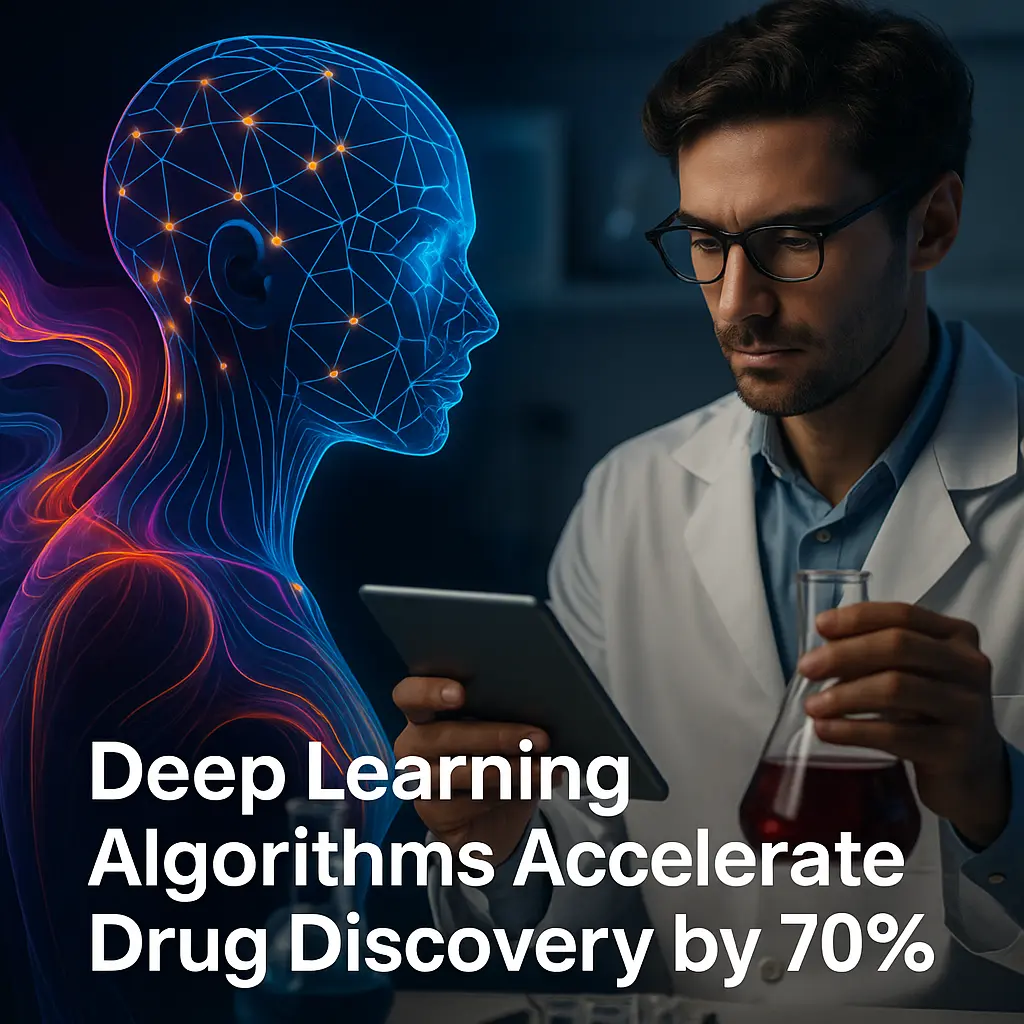
The pharmaceutical industry is experiencing a radical shift, as deep learning algorithms are now shortening the drug discovery process by up to 70%, according to a recent report by Nature Biotechnology. Traditionally a process that could span over a decade, the integration of AI has allowed companies to predict molecular behavior, simulate compound reactions, and even optimize clinical trial designs in mere months.
Firms like Insilico Medicine and BenevolentAI have already introduced AI-generated drug candidates that are in phase I human trials. This not only reduces costs by hundreds of millions of dollars but also dramatically improves the chances of success through data-driven targeting.
💡 In the digital sphere, platforms such as DICAPLO’s AI-Powered Advertising are using similar machine learning models to forecast audience behavior and personalize ad delivery, showcasing how deep learning bridges sectors beyond healthcare.
Moreover, the AI Content Creation division at DICAPLO draws inspiration from these advancements to automate and enhance long-form educational content about emerging technologies helping make complex science accessible to wider audiences.
Meanwhile, DICAPLO’s Website Design experts are already integrating real-time AI analytics dashboards into biotech and pharma websites, offering interactive platforms for researchers, investors, and patients alike.
As the world leans toward smarter, faster, and more ethical development in healthcare, deep learning algorithms are proving not just powerful but indispensable.
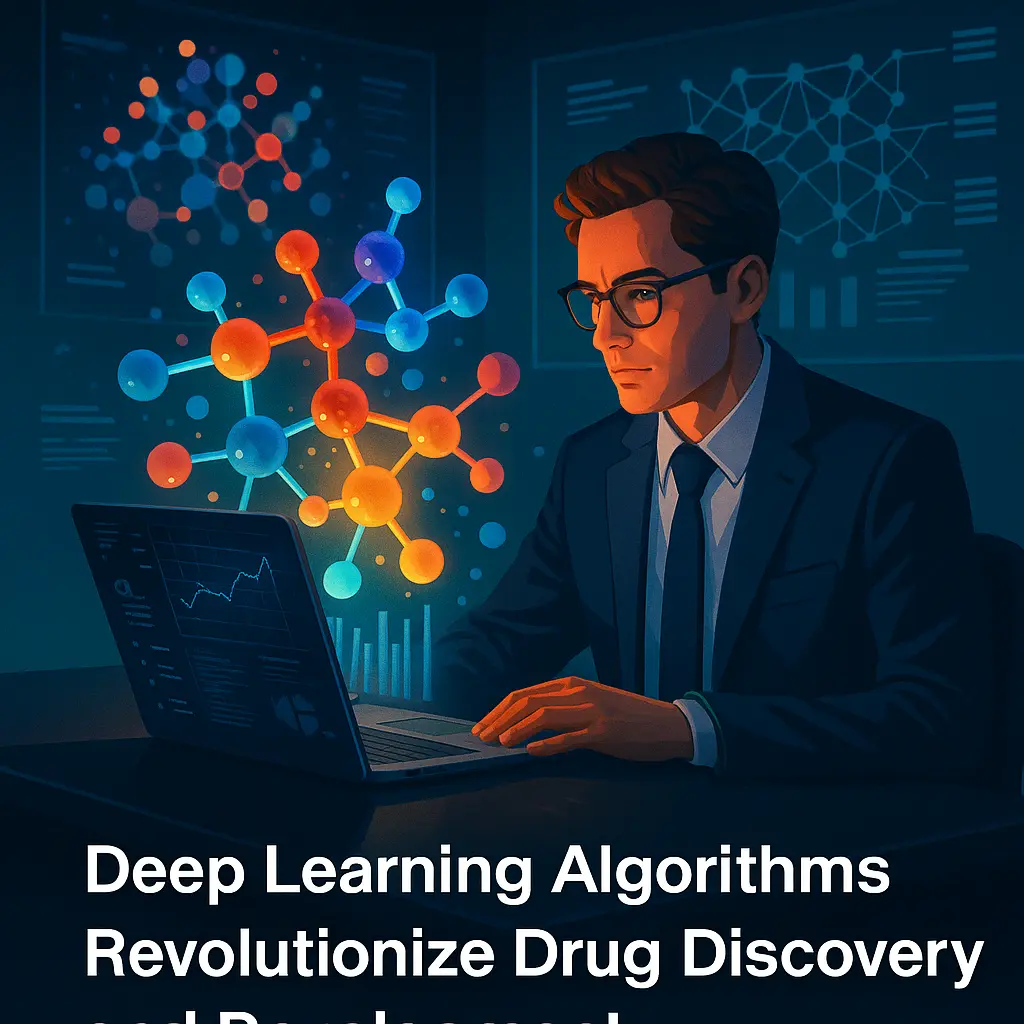
In a major leap forward for biomedical science, Deep Learning Algorithms are now being used to revolutionize the process of drug discovery significantly reducing the time, cost, and failure rate of pharmaceutical development.
A recent study published in Nature Machine Intelligence highlighted how deep generative models can predict the 3D structure of molecules and simulate their interactions with target proteins. This accelerates pre-clinical research by years, enabling faster responses to global health crises.
Startups like Insilico Medicine and Atomwise are at the forefront, combining AI and biotechnology to generate new chemical compounds in silico a method once considered futuristic. These platforms utilize Deep Learning Algorithms to analyze millions of data points from clinical trials, protein libraries, and genetic databases.
Meanwhile, innovation hubs such as MIT’s Computer Science and Artificial Intelligence Laboratory (CSAIL) and Stanford AI Lab are pushing the envelope with open-source models for pharma researchers worldwide.
On the internal innovation front, platforms like DICAPLO’s AI Content Creation and AI-Powered Advertising also demonstrate the potential of deep learning in crafting smart narratives for science and healthcare brands.
Whether applied in biotech, digital storytelling, or education, Deep Learning Algorithms are not just a trend they’re a revolution reshaping how we fight disease, communicate science, and build a healthier future.
🔍 Learn more on the DICAPLO Industry Blog or explore advanced medical datasets via The Human Protein Atlas.